




Food Machinery Takes Center Stage
On February 6, 2026, the draft of the National Food Safety Standard for Prepackaged Foods was released for public consultation, explicitly stipulating red lines such as 'no addition of presatives' and 'shelf life ≤ 12 months'.After the national standard, The competition has shifted from 'whose formula is better' to 'whose production line can stably replicate the good taste', and food machinery and equipment will play a leading roe. For food production enterprises and equipment purchasers, understanding the new requirements of national standards for equipment and grasping the technical trends are the key to winning the market.
1. Core Requirements of National Standard for Food Machinery
| National Standard Red Line | Requirements for Food Machinery |
| Preservatives must not be added | Preservation can only rely on physical methods: freezing equement must be faster and operate at lower temperatures; packaging equment must be more airtight and oxygen-isolated. |
| Shelf life ≤ 12 months | Short-term maintenance product lines require higher response speed and shorter production changeover time; flexible production lines have become a necessity. |
| Preservation of nutritional quality | Technologies such as slow cooking at low temperature, vacuum cooking, and infrared heating have been applied in industrial settings. |
| Traceability requirement | A full-chain traceability system should be established, integrating sensors into smart packaging to enable real-time quality monitoring and traceability through cloud-based data platforms. |
2. Trends of key equipment technology
(1) Ultra-low temperature quick-freezing equment: The era of "hard index" for freshness-locking technology has arrived
Cooling rate: Traditional freezers require 30 minutes to reduce the core temperature to-18 ° C, whereas the new-generation immersion-type freezer achieves a temperature drop from 80 ° C to-60 ° C in just 3 minutes. This represents not only a speed difference but also a qualitative improvement in cell damage rate, decreasing from 30% to 5%. Food manufacturers rely on this metric to produce products that are "as fresh as the original."
Energy consumption level: Food factories are now highly focused on operational costs. If you can provide equency with equivalent freshness-locking effects but lower energy consumption, it becomes a core competitive advantage.
(2) Intelligent Sorting and Cutting Equipment: From "Selling Machines" to "Selling Precision"
Cutting equipment: The competitive focus of automated bone sawing machines and cutting machines has shifted from 'whether they can cut' to whether the cutting precision can be controled at the millimeter level.
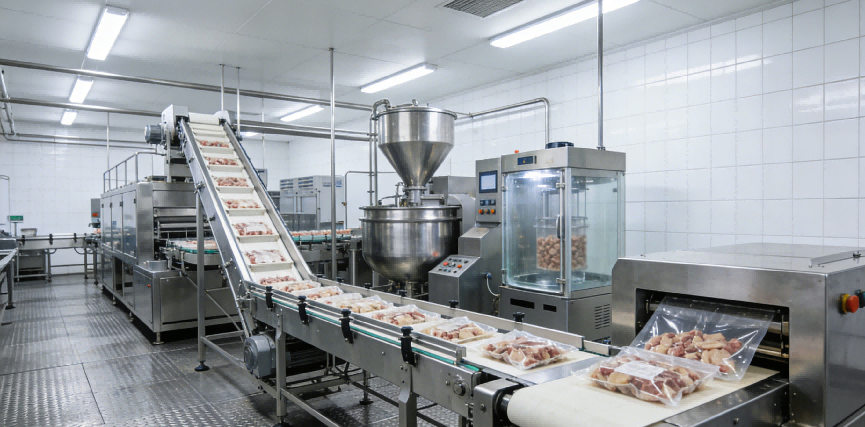
Weighing and Packaging Equipment: The core value of Multi-head Weigher(combined weighing and packaging machines) is to save labor for customers. One machine can replace 5-6 skilled workers, operating continuously 24/7 without complaints or errors.
Visual sorting equency: manual picking of foreign objects, color differences, and shape defects, which is inefficient and unstable. Sorting machines equipped with machine vision modules can achieve a misjudgment rate below 1%.
(3) Packaging and Cold Chain Equipment: A New track is Emerging
Modified Atmosphere Packaging Equipment: Modified Atmosphere Packaging Equipment (using nitrogen or carbon dioxide to replace air) will become a requirement in the future. However,modified bleud. Atmosphere Packaging Equipment is more expensive than vacuum packaging, if you can develop a controlled blued atmosphere packoraging machine with a modert price, simple operation, and suitability for small and medium wies-sized
Intelligent packaging equipment: The integration of gas sensors, temperature sensors, or the printing of freshness indicators into packaging materials is becoming a key advantage in thE bidding process for large food manfacturers. The equipment can be pre-equipped with data interfaces to enable the client's packaging line to connect to a traceability system.
Cold storage equipment: Multi-functional cold storage units and photovoltaic refrigeration systems are replacing traditional cold storage. You can focus on the "energy-saving" selling point-secondary condensation defrosting technology saves over 13% energy, and photoltaic refrigeration reduces daily electricity consumption from 1200 kWh to 800 kWh.
(4) Heat Pump Drying Equipment: A Neglected Sub-sector
Drying of aquatic products: Traditional sun-drying is affected by weather conditions, resulting in inconsistent quality; hot air drying consumes high energy and produces inconsistent product quality. Low-temperature heat pump dryers (below 30 ° C) can achieve low-salt drying (salt content <3%), preserving the fresh and tender texture of shrimp.
Drying of fruits and vegetables: lychee, longan, shiitake mushroom, barbarbarian wolfberry... Each category has different requirements for temperature, humidity, and duration. If you can develop a programmable heat pump dryer that can store multiple drying curves, you can serve multiple niche customers.
(5) AI and Intelligence: From "Optional Configuration" to "Standard Configuration"
Machine Vision: Install cameras during sorting and packaging processes, integrate with visual module suppliers, and utilize AI for automatic identification of foreign objects, color inconsistencies, and shape defects. Process Optimization: AI automatically adjusts freezing temperature and drying time based on raw material variations (e.g., sugar content, moisture level).
Flexible production line scheduling: After AI receives order information, it automatically plans the production sequence of difference products and equipment switching. This is most needed by food factories that handle multi-variety, small-batch orders.
Data interface: Temperature curve, runtime duration, fault records... If these data can be exported, uploaded, and integrated with the traceability system of food factories, your equment will have advantages.
3 .Market opportunities
The pre-prepared food market is projected to exceed 749 billion yuan in 2026, with the equipment segment accounting for approxyackate 150-200 billion chein, 15-70 billion
In the future, the food machinery industry will demonstrate three major trends: systematization of the entire equipment chain; localization of key equipment; and the transformation of AI from an option to a necessity. Concurrently, smart kitchen appliances (e.g., refrigerator-integrated cooking systems) will experience invation waves, creating new opportunities for B2B equipment manuacturers.